


Early outbreak alerts your team can explain
A model that predicts a dengue outbreak is useless if the health secretary cannot explain why the alert went off in that neighborhood and that week.
The problem
Outbreaks are detected late. Epidemics, climate change and population mobility increase health risks and, without predictive tools, the response comes afterwards.
Our approach
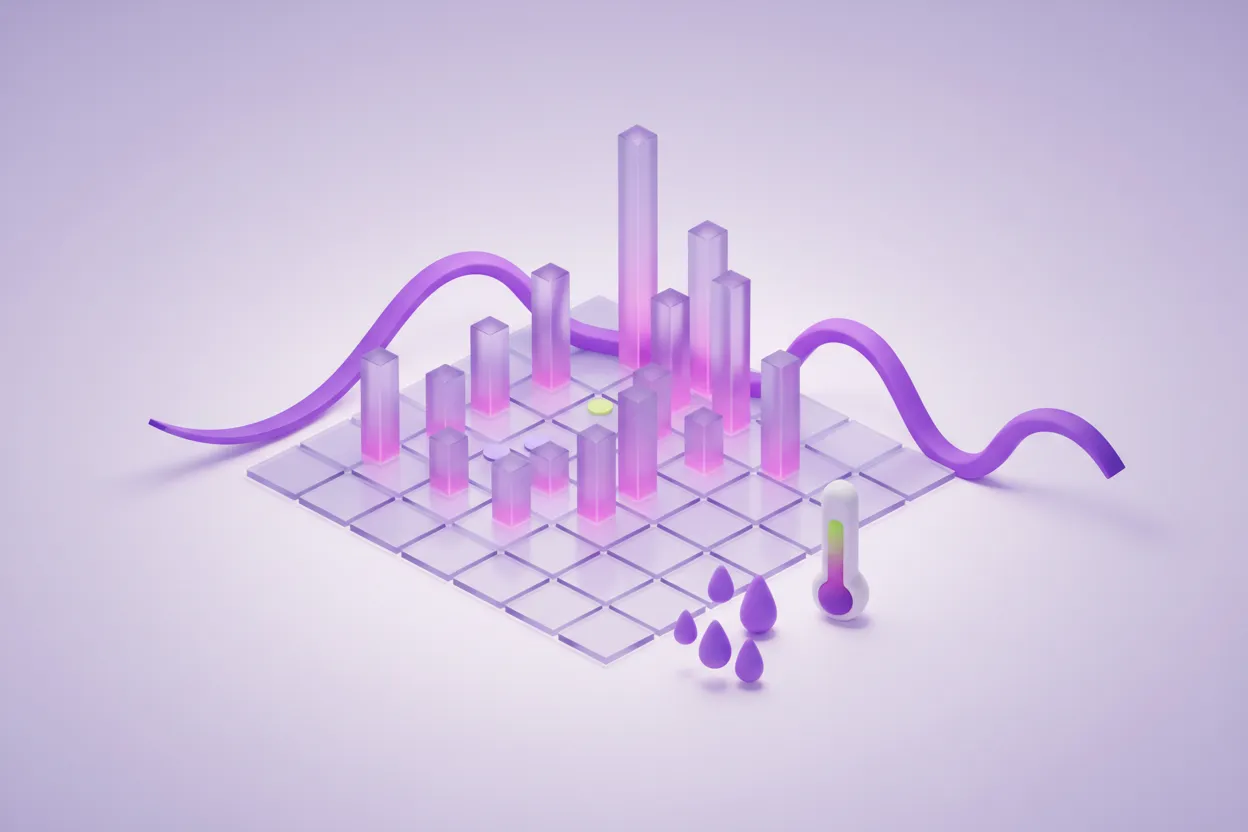
We build models that predict outbreaks from epidemiological, climate and mobility data, and that explain each alert: which variables weighed in, in which area and in which week.
Why is explainability a requirement and not an extra?
Public health decisions move field teams, beds and supplies, and someone is accountable for them. A black box does not stand up to that accountability.
That is why each alert must say why it was triggered: which variables weighed in, in which area and in which week. A team that understands the alert acts sooner and can defend it when it is questioned.
How do we do research?
The CuantaIA research group is conducting doctoral research on explainable AI for early outbreak warning. We work with internationally recognized methods.
Methods and data:
- Systematic literature review following PRISMA 2020.
- Risk-of-bias assessment of forecasting models with PROBAST, and reporting according to TRIPOD+AI.
- Explainability techniques such as SHAP, LIME and feature importance, as well as interpretable-by-design models.
- Model families ranging from time series (ARIMA and SARIMA) and decision trees (Random Forest and XGBoost) to deep learning (LSTM and graph networks) and compartmental epidemiological models (SEIR).
- Epidemiological surveillance, climate, mobility, remote sensing and digital signal data.
What can this do for your agency?
We combine open data, socio-environmental variables such as climate and mobility, and AI models to anticipate outbreaks of diseases such as dengue and Zika, support primary care with risk analysis and strengthen population surveillance.
What it delivers:
- Early warning dashboards that show why each alert is triggered.
- Forecasts with uncertainty intervals and thresholds tuned to your response capacity.
- Risk atlases by municipality and surveillance indicators through an API.
- Independent audits of the AI models your agency already uses or plans to buy.
- Technical explainability and validation criteria for procurement specifications.
Who is it for?
For health departments and epidemiological surveillance teams, and for agencies that buy or evaluate AI models in health.
We do not collect health data through this site: the conversation starts with your challenge, not with your data.
An open dataset on early outbreak prediction
The group published in open access the extraction table of its ongoing systematic review: 41 peer-reviewed studies from 2024–2025 on AI and machine learning models to predict infectious disease outbreaks, with 22 coded fields, including data sources, model types, metrics, explainability and risk of bias.
It is licensed under CC BY 4.0 and can be downloaded for free on Zenodo (DOI 10.5281/zenodo.21980058).
Frequently asked questions
What is explainable AI?
Models whose predictions can be explained: which variables weighed in and how much. It is achieved with techniques such as SHAP, LIME or feature importance, or with interpretable-by-design models.
What data do the models use?
Epidemiological surveillance, climate, mobility, remote sensing and digital signals. Climate series and satellite imagery come from open sources.
Can you review a model we already have?
Yes. We audit, independently, the AI models your agency already uses or plans to buy, with explainability and validation criteria.
Can I send patient data through the form?
No. We do not collect health data through this site. Tell us about your challenge without including patient information.
You may also be interested in
Open outbreak prediction dataset
41 studies from 2024–2025 on AI models to predict outbreaks, with 22 coded fields. Free download, CC BY 4.0 license.
Learn moreFree Applied Machine Learning course
From data to models that work in production: 11 sections and 63 lessons, free and taught in Spanish.
Learn more- GovTech
Public sector
We help public entities decide, specify and audit their technology: citizen services, records management and data.
Learn more