

Published on
Updated on
Business Automation with Artificial Intelligence: A Practical Guide

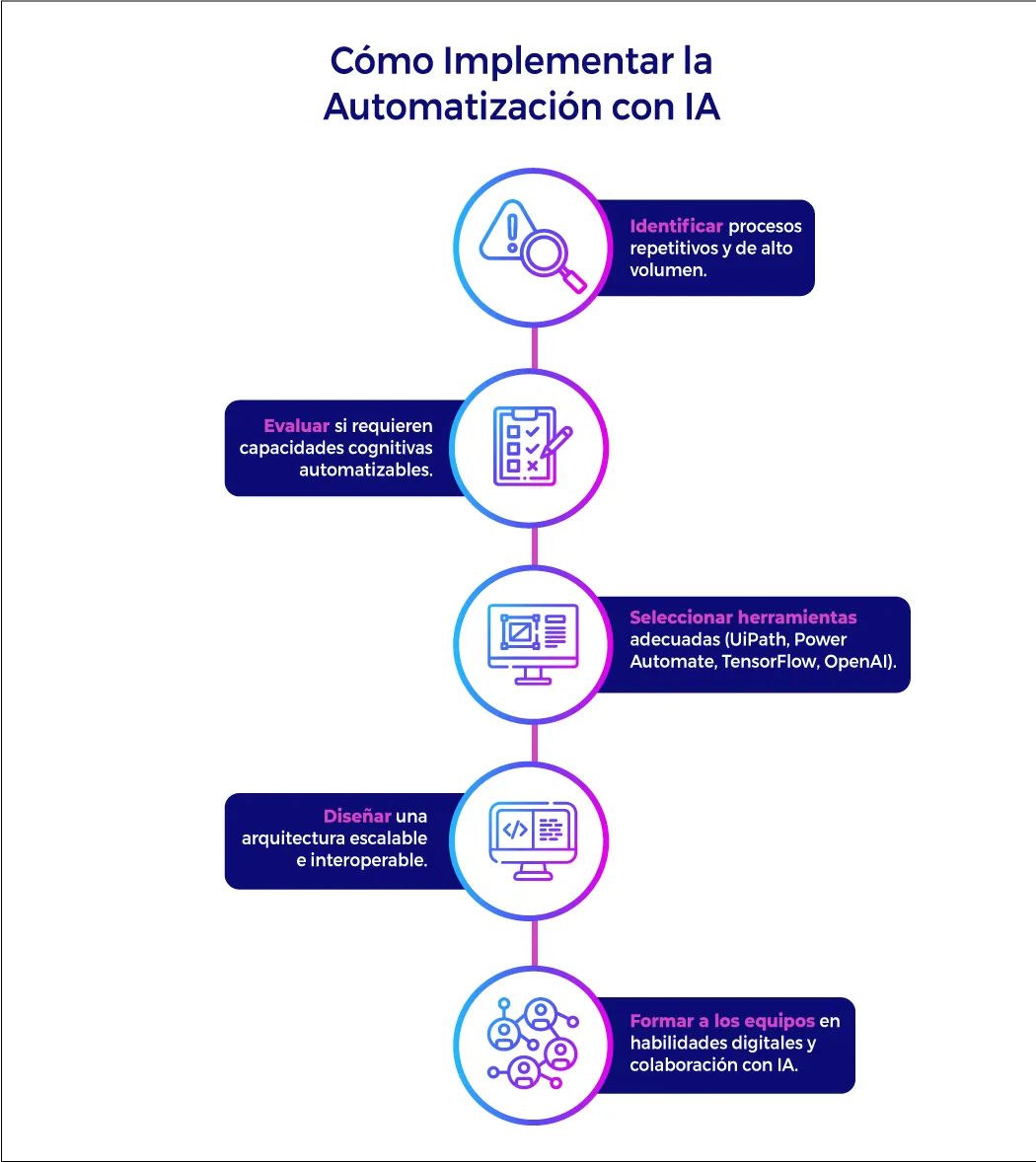
In a business environment where speed, efficiency, and adaptability define success, business automation has become a strategic necessity. When this automation is enhanced with artificial intelligence (AI), the result is a profound transformation in the way organizations operate, compete, and evolve. This practical guide is designed to provide a clear, technical, and actionable perspective on how to implement AI in companies to achieve true digital transformation.
¿What Is Business Automation?
Business automation consists of using technologies to carry out recurring or predictable tasks without direct human intervention. While it initially focused on ERP systems, macros, or scripts, today it has expanded into intelligent systems that integrate AI, enabling automated decisions and adaptive processes.
Artificial Intelligence and Its Role in Automation
Artificial intelligence (AI) makes it possible to go beyond the limits of traditional automation. By incorporating techniques such as machine learning, natural language processing, and predictive algorithms, it is possible to automate cognitive tasks, analyze large volumes of data, and deliver highly personalized services.
In logistics, Amazon uses AI to optimize routes and manage inventory in real time. IBM and Microsoft, meanwhile, have shown that companies leading in AI adoption can increase their profits by up to 70% compared to their peers.

Benefits of AI-Powered Automation
- Cost reduction through inefficiency detection.
- Greater accuracy by eliminating human errors.
- Improved decision-making with real-time data.
- Scalability without increasing operational infrastructure.
- Mass personalization of products and services.
Global Impact and Stance of International Organizations
- UN and ILO: The UN promotes ethical and equitable AI. The ILO estimates that AI will partially affect up to 80% of jobs, but will fully automate only about 5%. Their approach is to complement, not replace.
- World Bank: Warns that between 26% and 38% of jobs in Latin America could be transformed by generative AI. It recommends closing digital gaps, investing in training, and modernizing labor regulations. World Bank (2024). Economic Outlook for Latin America and the Caribbean 2024. (opens in a new tab)
- IDB: Highlights that 43% of jobs in the region are at risk due to automation, but also projects that AI could add up to 1 percentage point of annual economic growth if properly managed. IDB (2023). The Future of Work in Latin America and the Caribbean: The Impact of Automation and Artificial Intelligence on Employment and Productivity. (opens in a new tab)
Challenges and Ethical Considerations
- Digital gaps that limit access to technology.
- Algorithmic biases that can reproduce inequalities.
- Data privacy and security.
- Transparency in automated decision-making.
- Human oversight and accountability for system errors.
Organizations such as the OECD and Microsoft recommend frameworks for responsible and transparent AI. Google and OpenAI, in turn, actively participate in shaping global regulations.
Vision in Colombia: Public Policy and Business Leadership
Colombia has taken an active stance in incorporating artificial intelligence into business automation:
- In 2025, Colombia adopted the National Artificial Intelligence Policy (CONPES 4144), with an investment of COP 479 billion through 2030. The strategy promotes ethical AI use, digital strengthening, and technological inclusion, highlighting the creation of 73 micro-training centers and the expansion of the SofisTICa program for SMEs and public entities.
- CUANTICO, a GovTech and applied artificial intelligence company, drives the digitalization of the public sector with solutions such as EDMS, LMS platforms, traceability systems, chatbots, and data observatories. Through its CuantaIA group, it develops advanced analytics, machine learning, and natural language processing to promote ethical and strategic AI use.
These advances demonstrate that AI-driven automation is not exclusive to major powers but is an expanding reality in Latin America, with Colombia serving as a benchmark in public policy and innovative business ecosystems.
Business automation through AI represents a natural evolution toward more efficient, intelligent, and human-centered processes. It is not just about technology, but about strategy, ethics, and adaptation. Information supported by institutions such as the UN, the World Bank, and companies like IBM, Microsoft, and CUANTICO reinforces this message: automating with AI is a step toward a more agile, inclusive, and future-ready enterprise.
Discover How AI Is Revolutionizing the Way You Work
Do you know how much time and effort you could save with intelligent automation?
Download our free PDF “Tasks Before vs. After AI Automation (opens in a new tab)” and clearly visualize how repetitive and manual tasks have evolved thanks to artificial intelligence.
- Time savings
- Greater accuracy
- Fewer errors
- Faster decision-making
Want to bring AI into your organization?
We build business intelligence, predictive models and agents on top of the ERP you already use, with a person in the loop for what matters.